Richmond metro · Driveways and parking lots
The clay decides, and the asphalt only reports the verdict
Nearly every driveway question in this region turns out to be a question about water: where it goes, how long it stays, and what the red Piedmont clay underneath does while it is there. Answer that and the paving decision answers itself. Skip it and you buy the same driveway twice.
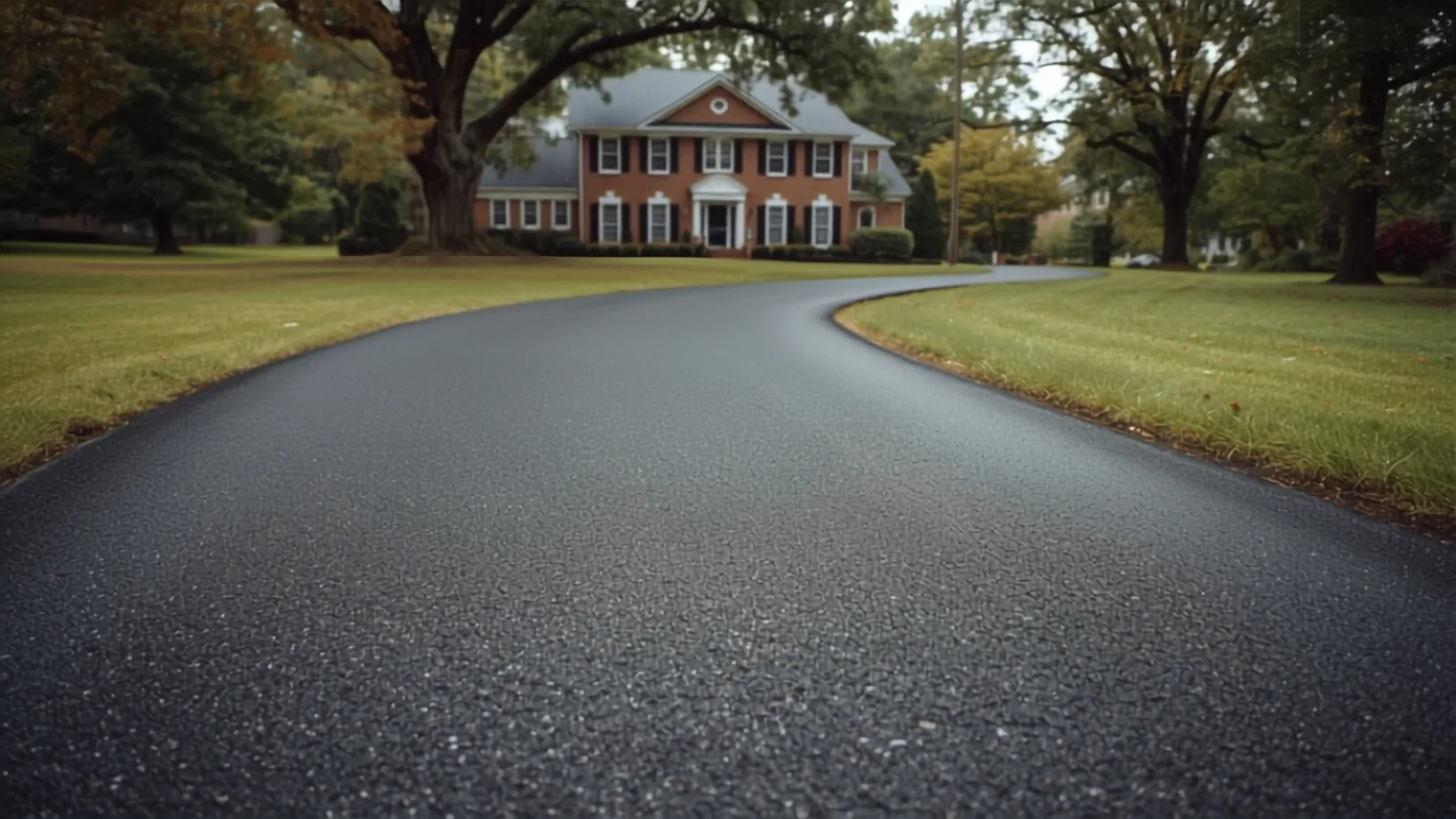
A driveway is three layers and only one of them is black
The part you can see is the wearing course, and it is the thinnest, cheapest and least structurally important element in the whole assembly. Its job is to shed water and take tyre wear. It is not what carries the car.
Underneath sits a compacted aggregate base, usually crushed stone, and its job is to take a concentrated wheel load and spread it out over a wide enough area that the ground beneath can carry it without deforming. Beneath that is the subgrade, which in most of this metro means Piedmont clay, and clay has one relevant property above all others: what it can carry depends almost entirely on how wet it is.
That is the whole mechanism. Dry clay is a competent foundation. Saturated clay is not, and a base sitting on saturated clay will move under load. When it moves, the asphalt above it has nothing to do but crack, because asphalt is flexible but not infinitely so.
So the single most useful question about any driveway or lot in this region is not what the surface looks like. It is whether water is getting into the base and, more importantly, whether it has any way of getting back out.
Reading a Richmond driveway
Pavement distress is legible. The pattern tells you which layer has the problem, and that distinction is worth thousands of dollars because surface problems and structural problems cost completely different amounts to put right.
Interconnected cracking in a pattern like reptile skin
Usually called alligator cracking, and it is the clearest structural signal there is. It means the pavement is flexing under load because the base beneath it can no longer spread that load out. It concentrates where vehicles sit, turn and stop — the apron in front of a garage, the turnaround, the section where a delivery truck backs in.
Nothing applied to the top of an alligatored area fixes it. Sealer over that pattern seals the evidence and leaves the cause running. The area has to come out, the base has to be addressed, and new material has to go back in.
Edges that crumble and break away
Extremely common on residential drives here and almost always a construction or a drainage story rather than a material one. Asphalt has no edge restraint; it is only as strong at the perimeter as whatever supports it laterally. Where the shoulder has eroded, where a mower wheel has worn a channel alongside, or where water runs down the edge every time it rains, the material loses its support and breaks off in pieces.
Building the shoulder back up to meet the pavement is unglamorous and it is frequently the single highest-return thing that can be done to a rural drive in Powhatan or western Chesterfield.
Potholes
A pothole is a hole in the surface that is reporting on a void underneath it. Water got into the base, softened or washed out material, the unsupported asphalt above broke through, and now traffic is enlarging the opening every day.
That is why a pothole in the same spot for the third time is not bad workmanship. It is a diagnosis nobody acted on. The cause is almost always water, and until the water is dealt with, filling the hole is a subscription rather than a repair.
Single cracks running along or across the drive
Longitudinal cracks follow the direction of travel, often along a cold joint where two passes of paving met. Transverse cracks run across it and are usually thermal — asphalt contracts as it cools in winter and pulls itself apart at its weakest line.
On a sound pavement these are maintenance items and good news. Sealed while they are still isolated, they stop being a route for water into the base, which is exactly the intervention that prevents the expensive failures above. Left open through a winter, they are how those failures begin.
A grey, rough, slightly gravelly surface
This is raveling, and it is the binder oxidising and releasing the aggregate it was holding. The surface loses fines first, then feels like coarse sandpaper, then sheds visible stone. It is genuine ageing rather than failure, and it is the condition sealcoating is actually designed for.
Depressions that hold water after rain
A birdbath is a low spot, and a low spot is nearly always a report from below the surface rather than from the surface itself. Either the subgrade settled there, or the drive was never graded to shed water in that direction.
Either way the depression is now a water-delivery system aimed at its own base, which means it will get deeper. On a clay subgrade this is the failure that compounds fastest, because the clay directly under a puddle is the wettest clay on the property.
Heave and humps under the canopy
This region has an old and generous tree canopy, and the trees are frequently older than the driveways. Roots looking for water follow the edge of a pavement, get under it, and lift it. The resulting hump cracks in a rough ring, and the crack lets water down to the root, which encourages it further.
Repaving over a live root buys a season or two. What the situation needs is a decision about the root, made with the tree in mind, before anything black goes down.
Request a callback
Send the address and what the surface is doing. We will call you back.
Talk through your site
A site visit and twenty minutes looking at where the water goes answers most of it. Send the address and roughly how long the drive is.
What we do
Driveway Paving
New asphalt drives, replacements and widenings, from the subgrade up.
Driveway Repair
Potholes, edge failure, settling and the cracks worth chasing.
Sealcoating & Driveway Sealing
What it protects, what it cannot fix, and when it is money wasted.
Asphalt Repair
Patching, full-depth repair and reading what a failure is telling you.
Parking Lot Repair
Keeping a working lot open while the failed areas get rebuilt.
Parking Lot Paving
New lots and full reconstruction for commercial and multifamily sites.
Parking Lot Striping & ADA Layout
Layout, stall counts, accessible spaces and fire lanes.
What central Virginia does to asphalt
Richmond is not a punishing climate for pavement in the way that the upper Midwest is, and it is not a punishing climate in the way that the desert Southwest is. It is punishing in its own particular way, and the combination is unusual.
Clay that holds water against the base
The defining local condition. Piedmont clay drains slowly, which means water that gets under a pavement stays under it for days or weeks rather than hours. A saturated subgrade loses bearing capacity, and a base with no bearing capacity beneath it deforms under every vehicle that crosses it.
A freeze-thaw season that is short but sharp
Winters here are mild by national standards, which leads people to discount freeze-thaw entirely. That is a mistake. What damages pavement is not how cold it gets but how many times it crosses freezing, and a Richmond winter crosses back and forth constantly — below overnight, above by mid-morning, repeatedly, for months. Water sitting in a crack expands each time it freezes and levers the crack open a little wider.
Humid heat and a softer surface
Summer surface temperatures get high enough that asphalt becomes noticeably plastic. A vehicle parked in the same spot, a trailer jack, a kickstand or a dumpster wheel can press permanent impressions into a surface that would shrug them off in April.
Shade, pollen and what grows in it
A heavily shaded drive stays damp long after the rest of the property has dried, and persistently damp asphalt supports moss and algae that hold yet more moisture against the surface. Spring pollen adds an organic layer that does the same thing. Neither destroys pavement on its own; both extend the time the surface spends wet, which is the thing that matters.
Rain that arrives in volume
Tropical remnants reach this region most years and deliver several inches in a day. A drainage arrangement that copes with ordinary rainfall can be comprehensively overwhelmed by that, and where the water goes when it is overwhelmed is where the next failure will be.
Spending in the right order
The most expensive mistake in residential paving is not choosing a bad contractor. It is doing good work in the wrong sequence, which produces a result that looks correct for a year and then fails anyway, with the money already spent.
- Work out where water goes. Grading, shoulders, the low spots, the downspout that discharges onto the drive. This is first because everything after it is affected by it.
- Fix what has failed structurally. Full-depth repair of the alligatored areas, the potholes and anything sitting over a soft base. This is the part nobody wants to pay for and the part everything else depends on.
- Deal with the cracks that are still just cracks. Sealing isolated cracks on a sound pavement is the highest-return maintenance there is, precisely because it keeps water out of a base that is currently fine.
- Then, and only then, consider the surface. Resurfacing or sealcoating is a decision about appearance and about slowing oxidation. Neither adds structural capacity, and both are wasted money if applied over a structure that is already going.
Reversing steps two and four is the classic and costly error. An overlay placed over a failing base reproduces the failure straight through the new surface, usually inside two years, and the second repair now has to remove the new asphalt as well as the old.
What sealcoating is and is not
More money is wasted on sealcoating in this region than on any other single item, and the reason is that it is sold as maintenance when it is really cosmetics with a modest protective benefit.
What it genuinely does: it puts a sacrificial layer over an oxidising surface, slows ultraviolet and moisture attack on the binder, resists fuel and oil spotting, and makes a tired drive look new. On a structurally sound pavement, applied on a sensible interval and not over-applied, it is worth doing.
What it does not do: add a single unit of structural capacity, bridge a crack that is moving, fix a depression, or slow any failure that originates underneath. Applied too often or too thick, it builds up and cracks in its own right, which looks like pavement failure and is not.
The honest test is simple. If the drive is sound and merely grey, sealer is a reasonable purchase. If water stands on it, if the cracks form patterns rather than lines, or if there are patches that have been replaced more than once, sealer is a cover over a problem that is still getting worse underneath it.
Where we work
The metro is not uniform. The soil changes across the fall line, the housing stock ranges from pre-war to still-settling, and a four-hundred-foot rural approach has almost nothing in common with a suburban apron.
Powhatan
Long rural drives, gravel conversions and gravity that works against you.
Chesterfield
Suburban drives and the county clay that decides how long they last.
Glen Allen
West-end subdivisions, commercial strips and tight HOA standards.
Ashland
Older streets, mature trees and root damage under the mat.
Mechanicsville
Hanover-side drives and a lot of deferred maintenance.
Midlothian
Newer construction on ground that has not finished settling.
Chester
South-side drives, commercial frontage and heavy truck traffic.
Getting quotes you can actually compare
Three proposals for the same driveway can differ by a factor of four and every one of them can be honest, because they are not describing the same job. Until the scope is settled, the numbers are not comparable and the lowest one usually wins for the wrong reason.
Ask every bidder the same questions and the picture resolves quickly:
- What thickness of asphalt, placed in how many lifts, and compacted how?
- What depth of stone base, and is the existing base being reused, supplemented or replaced?
- Is any of this full-depth repair, or is it all surface work over what is already there?
- What is being done about drainage, specifically, and where will water go afterwards?
- How are the edges being supported once the work is finished?
- If a tree root is involved, what is the plan for the root as opposed to the pavement?
- What is excluded from the price?
A proposal that answers those is a scope. One that says the drive will be paved is a number with a story attached to it, and the story can change after the equipment arrives.
Richmond asphalt questions, answered straight
How long should an asphalt driveway last in the Richmond area?
That depends far more on drainage than on the asphalt. A drive built on a sound stone base that sheds water properly has a long service life with periodic crack sealing. The same asphalt over a base that stays wet can be in structural trouble within a handful of years. Where water goes is the variable that decides it.
Can you pave over my existing driveway instead of tearing it out?
Sometimes. An overlay works where the existing pavement is structurally sound and the problem is genuinely the surface. It is the wrong answer where the base has failed, because the same cracking telegraphs straight through the new layer, usually within two years, and the eventual repair then has to remove both layers.
Why does my pothole keep coming back in the same spot?
Because the hole is a symptom and the cause has not been addressed. Water is getting into the base there and softening or washing out material, so the patch sits over a void that keeps re-forming. Until the water is dealt with, refilling it is a recurring cost rather than a repair.
Is sealcoating worth the money?
On a structurally sound drive that has simply gone grey, yes, at a sensible interval. It slows oxidation and it improves appearance. On a drive where water stands, where cracking has formed patterns rather than lines, or where patches keep failing, it covers a problem that carries on getting worse underneath it.
Can I convert a gravel driveway to asphalt?
Usually, and the honest answer generally has more to do with grading and drainage than with asphalt. A long rural approach in Powhatan or western Chesterfield is a drainage project that ends in a black surface. The existing gravel may be usable as part of the base or may need to be supplemented or replaced, which the site visit settles.
What time of year is best for paving here?
Hot mix needs to be placed and compacted within a temperature range, so the broad season runs from spring through autumn. The more useful timing question is crack sealing, which is best done before winter, because an open crack going into a freeze-thaw season is how the expensive failures start.
A tree root has lifted part of my driveway. What are the options?
That needs a decision about the root before any decision about the pavement, made with the health of the tree in mind. Repaving over a live root buys a season or two and then the hump returns, because the root is still growing and the crack ring is still letting water down to it.
Why are the quotes I am getting so different from each other?
Because they are almost certainly describing different jobs. One may be pricing a surface and another a structure, and both can be honest. Asking every bidder the same questions about thickness, base depth, full-depth repair areas and drainage is what makes the numbers comparable.
Talk through your site
Send the address, roughly how long the drive is, and what is bothering you about it. Photographs of the worst areas, and of anywhere water sits after rain, are the most useful thing you can include.